10:00 am - 11:00 pm
Sunday Service
South Pasadena Christian Church
Worship Service – Sundays at 10am
Prayer Service – Tuesdays at 6:15pm
English Bible Study – Thursdays at 7pm
Chinese Bible Study – Fridays at 7pm
If you are looking to connect to a church community that doesn’t expect you to have everything figured out, but will accept you, encourage you, and walk with you as you mature in your faith, then we invite you to join us.
We have a dedicated team of prayer warriors who would love to pray for your needs and the needs of those you love. We pray for those on our prayer list weekly and look forward to getting your requests.
“And the prayer offered in faith will make the sick person well; the Lord will raise them up. If they have sinned, they will be forgiven.” (James 5:15)
To sow and cultivate a life of faith, love and service in the name of our Lord and Savior, Jesus Christ, founded upon the Bible, the Living Word of God, with the love and guidance of the Holy Spirit.

If you are looking to connect to a church community that doesn’t expect you to have everything figured out, but will accept you, encourage you, and walk with you as you mature in your faith, then we invite you to join us.
We have services on Sundays at 10:00 am, English Bible Study on Thursdays at 7:00 pm and Chinese Bible Study on Fridays at 7:00 pm. Check out our Calendar for more special events and gatherings.
South Pasadena Christian Church, a congregation of the Christian Church (Disciples of Christ), is a vibrant church that has been in South Pasadena since 1906. As one of the oldest denominations on American soil, the Disciples of Christ have a long heritage of openness to other Christian traditions having come into existence as a 19th century protest movement against denominational exclusiveness. At the local level and beyond, Disciples of Christ are frequently involved in cooperative and ecumenical work.
You will also notice that we are a diverse community. We are diverse in so many ways: race, color, age, ethnicity, national origin, financial means, education, language, gender, and political perspective to name a few. Even though we are varied, when we gather together on Sundays, we do it as one family of faith.
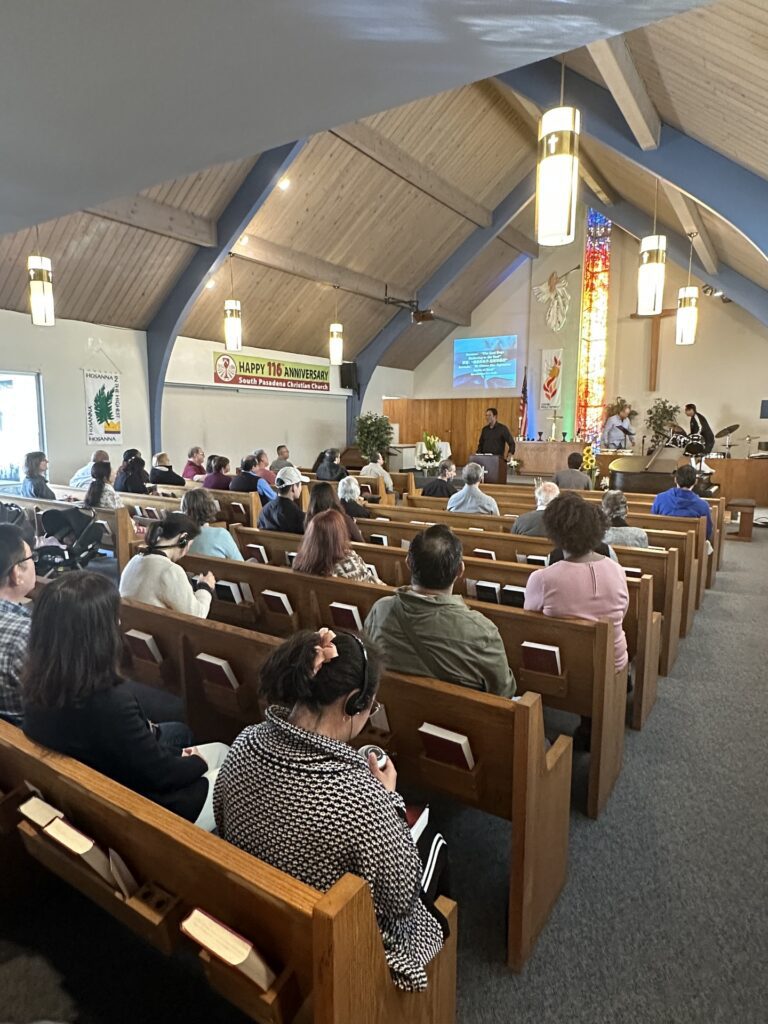
The Sunday service is a time for us, as Christians, to remember and proclaim what God has done, is doing, and will do in the world through our faith in Jesus. During our gathering together, we sing contemporary songs and hymns, we welcome children, we pray together, and we read from the Bible. We also share in Communion every week as an expression of our shared faith and unity in Jesus.
We seek to preach the story of God from the Bible. We ask hard questions and attempt to offer straight forward answers. We take seriously the call to bear witness to God’s redemptive work in the world through Jesus.
Come join us on a Sunday morning!

SPCC offers Children and Youth Ministries for kids ranging from ages 3-12. Check out the information below to select the perfect program for your little ones! Classes are Bible based and loads of fun!
Infants and toddlers from 3 months to 3 years old have supervised play time in our Nursery, adjoining the fellowship hall.
Children ages 4-8 meet in the Children’s Worship Center off the patio for Children Worship & Wonder. There they hear and see Bible stories acted out with wooden figures that they can also use on their own. In a Montessori-style environment, they learn about God in a hands-on developmentally appropriate manner. The children are invited to enter into the stories and form responses out of their own life experiences. This way of being in worship with children is based on the assumption that children already have a relationship with God. Children Worship & Wonder provides children with the tools, the language and the safe space to deepen their relationship with God.
Youth ages 9-15 meet upstairs for the L&L (Lions and Lambs) youth group where they read and discuss the Bible while they connect with each other and with God. L&L is serious about teaching the Bible and making it relevant to our youth. During their studies, the youth have opportunities to earn SPCC Bucks to purchase from a selection of cool prizes. Thursday evenings are also a time where the youth meet to fellowship, have pizza and snacks, play games including PlayStation competitions. The youth have discussions about whatever is on their minds and have a chance to give their input about the direction of the group including planning future outings and trips. L&L is a friendly, diverse, safe and fun place for youth.

Our After-Church Lunch program, which takes place immediately after the main worship service, provides the setting in which our church members and visitors can build relationships. We enjoy sustenance for the mid-day meal, while experiencing the warmth for the Heart and Spirit that this opportunity to “break bread” offers. All are welcome!
South Pasadena Christian Church has a history of over 100 years of ministry. Our mission is to sow and cultivate lives of Christian faith, love and service in the spirit of unity that is foundational to who we are and what we believe.
We are located in the heart of South Pasadena on the corner of Fremont and Lyndon, just north of the High School. If our parking lot is full, there is street parking as well as parking at the High School, either off of Lyndon or Fremont.